Research Article | | Peer-Reviewed

Effect of Organic and Chemical Fertilizers on the Growth and Diseases of Strawberries (Fragaria ananassa var Charlotte)

Published in Plant (Volume 14, Issue 1)
Received: 18 March 2026     Accepted: 27 March 2026     Published: 20 April 2026
Views:       Downloads:
Abstract

The intensification of agriculture and the ongoing degradation of soils in the highlands of western Cameroon are compromising the sustainability of vegetable production systems, particularly that of strawberries (Fragaria ananassa), a crop that is increasingly valued in the region. This study aims to evaluate the effect of different types of organic amendments (chicken manure and compost) and mineral amendments (NPK fertilizer) on the growth and health of strawberry plants. The experiment was conducted using a completely randomized block design with six treatments: a control (T0), two doses of chicken manure (20 t/ha, T1; 30 t/ha, T2), two doses of compost (10 t/ha, T3; 20 t/ha, T4) and a chemical treatment (NPK 14-24-14 at 100 kg/ha, T5), each repeated three times. The parameters studied included: vegetative growth (height, leaf area, stolons), incidence and severity of leaf diseases. Pathogens were identified using identification keys and microscopic observations of pure strains obtained on PDA medium. The results revealed that organic amendments significantly improved plant growth. Manure at 30 t/ha (T2) generated the best performance in terms of vegetative growth. However, high-dose treatments (T2, T4) and chemical fertilizer (T5) were associated with a higher incidence of fungal diseases, with Colletotrichum sp., Fusarium sp., and Mycosphaerella sp. identified as the main pathogens. Compost at 10 t/ha stands out as the most effective amendment, combining agronomic performance and disease resistance. The adoption of organic fertilizers could therefore be a significant asset in sustainably improving strawberry production in the highlands of western Cameroon.

Published in Plant (Volume 14, Issue 1)
DOI 10.11648/j.plant.20261401.12
Page(s) 24-32
Creative Commons

This is an Open Access article, distributed under the terms of the Creative Commons Attribution 4.0 International License (http://creativecommons.org/licenses/by/4.0/), which permits unrestricted use, distribution and reproduction in any medium or format, provided the original work is properly cited.

Copyright

Copyright © The Author(s), 2026. Published by Science Publishing Group

Keywords

Fragaria ananassa, Compost, Chicken Manure, Chemical Fertilizer

1. Introduction
Urban agriculture is a rapidly expanding phenomenon in Africa, where it plays a crucial role in food security and economic development. In Cameroon, this practice is particularly relevant in urban and peri-urban areas, where demand for fresh produce is growing rapidly. According to statistics, approximately 60% of Cameroon's population lives in urban areas, and this proportion continues to increase, highlighting the need for sustainable and accessible agriculture In the highlands of western Cameroon, particularly in Dschang, farmers take advantage of favorable climatic conditions to grow various crops, including strawberries. The strawberry (Fragaria ananassa Duch.) is a small fruit-bearing plant with red berries, belonging to the Rosaceae family and the Fragaria genus. It is a perennial herbaceous plant with a fibrous root system It is one of the most widely grown fruit crops in the world . According to FAO reports, global strawberry production exceeded 9.18 million tons in 2021. Asia is the largest continental producer (4.53 million tons), followed by America (2.18 million tons), Europe (1.76 million tons), Africa (634,290 tons), and Oceania (60,310 tons) It is recognized that strawberries are classified as recently introduced exotic plants, and their cultivation continues to spread increasingly throughout Africa. Despite its wealth of five agroecological zones and its description of Africa in miniature Cameroon is one of the countries where strawberry cultivation is still booming Production remains very low for the most part, diseases are poorly understood, and documentation in Cameroon is scarce. In order to expand the production of this crop in our country, especially in the context of urban agriculture, farmers use fertilizers (chemical and organic) and pesticides to increase yields and satisfy the population. However, in order to promote agriculture that respects the health of the environment and humans, it would be wise to assess the effects of these fertilizers on the spread of disease and the quality of plants. Despite the region's agronomic potential, farmers in Dschang face significant challenges related to soil fertility. Although research has been conducted on the impact of organic and chemical amendments on other crops, there is a lack of specific data on their effect on strawberry cultivation in the western highlands of Cameroon. The absence of scientific data on fertilizer use in strawberry production prevents farmers from farmers to make informed decisions about the amendment practices to adopt in order to improve the quality of their crops. Hence the objective of this study, which aims to evaluate the effect of different types of organic amendments (chicken manure and compost) and mineral amendments (NPK fertilizer) on the growth and health of strawberry plants in the highlands of western Cameroon.
2. Materials and Methods
2.1. Materials
2.1.1. Location of the Study Area
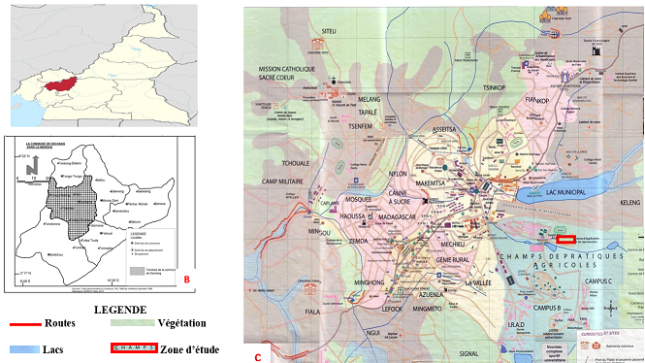
The study was conducted partly in the laboratories of the Applied Botany Research Unit (URBOA) the Applied Phytopathology and Zoology Research Unit (URPHYZA) at the University of Dschang, and on an experimental plot belonging to the Department of Plant Biology at the University of Dschang, in the West Cameroon region, in the Menoua department at an altitude of 1,405.759 m above sea level and with geographical coordinates of 5°26΄40.26588 ̎ north latitude and 10°4΄3.10188 ̎ east longitude (Figure 1).
Figure 1. Location of the study area.
2.1.2. Plant Material
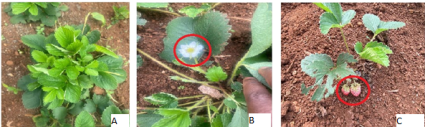
The Charlotte strawberry cultivar was used. This variety is vigorous and hardy, with rapid growth and medium-sized, rounded, conical fruit that is sweet with low acidity, firm and soft flesh, and a bright red color. The adult plant measures 20 to 30 cm in height and has a vegetative cycle of 3 months (Figure 2).
Figure 2. Morphology of Fragaria ananassa var char (A: Plant, B: Flower, C: Fruit).
2.1.3. Fertilizers
The fertilizers used during this experiment consisted of organic fertilizers, namely compost and chicken manure, and the chemical fertilizer NPK (14-24-14), commonly used for strawberry cultivation.
2.2. Methodology
2.2.1. Experimental Setup
The experiment was conducted in a completely randomized block design with 3 replicates and 6 treatments. The treatments used were: T0 (0 t/ha), T1 (20 t/ha of chicken manure), T2 (30 t/ha of chicken manure), T3 (10 t/ha of compost), T4 (20 t/ha of compost), T5 (NPK 100 kg/ha). Each of the experimental units had an area of 1 m² with 6 plants spaced 0.5 m apart, i.e., 1 m between rows and 0.5 m within rows. An area of 100 m² was used with a total of 108 plants for our experiment.
2.2.2. Evaluation of Growth Parameters
Growth parameters such as plant height, number of leaves, and number of stolons were measured and counted weekly.
Leaf area was measured using the following formula: Leaf Area = 0.73*Length*Width All these parameters were evaluated on four plants from each experimental unit.
2.2.3. Isolation of Fungi Associated with Diseases Observed in the Field
(i). Collection of Samples of Leaves Showing Disease Symptoms
Samples of leaves showing disease symptoms were collected early in the morning from the various experimental plots, wrapped in blotting paper soaked in distilled water, and taken back to the laboratory for culture.
(ii). Culture and Identification of Fungi
The apparently healthy leaves were disinfected using a 2% sodium hypochlorite solution for 3 minutes, then rinsed three times with distilled water for 5, 10, and 15 minutes. They were spun dry to remove excess water, then the fragments were seeded in Petri dishes containing PDA medium. These plates were then sealed with plastic wrap and incubated in an incubator. The fungi that developed around the seeded fragments were separately transferred, according to their morphology and color, to Petri dishes containing PDA medium to obtain pure cultures The isolates obtained were identified by mounting the mycelium from pure cultures on slides and then observing them under an electron microscope at 400X magnification.
2.2.4. Incidence and Severity of Diseases
(i). Incidence
Incidence was obtained by counting the number of diseased plants relative to the number of healthy plants for each disease, using the following formula:
Incidence = ((number of diseased plants/number of healthy plants) *100)
(ii). Severity
Severity was obtained by assessing the degree of attack on each leaf and using a rating scale from 0 to 5 to estimate the severity of the disease, then the following formula was used:
Severity = ((∑ (severity class*number of leaves per class) /total number of leaves*maximum class) *100).
Table 1. Severity scale

Class

Percentage of diseased surface

Visual description

0

0%

No lesion

1

1-10%

Little affected leave, some small stains

2

11-25%

Slightly more pronounced spots, several scattered spots

3

26-50%

Almost half of the leaf attacked

4

51-75%

More pronounced attack covering more than half of the leaf

5

76-100%

Leaf completely attacked

2.2.5. Pathogenicity Test
In order to verify whether the isolated microorganism was indeed responsible for the symptoms observed on the strawberry leaves, a pathogenicity test was carried out according to Koch's postulates. Inoculation was performed on apparently healthy Fragaria ananassa leaves. The leaves were disinfected. These leaves were then placed in a tray containing blotting paper soaked in distilled water.
The mycelia of the pure strains of each fungus were collected using tweezers and placed on the surfaces of the leaves. The boxes were labeled and incubated for 10 days.
2.2.6. Statistical Analyses
All data collected on plant growth, disease, and quality were classified and processed using Microsoft Excel software. Normality of distribution and homogeneity of variance were tested prior to performing analysis of variance (ANOVA). The means were compared using multiple PPDS tests at a 5% threshold to determine statistical differences between treatments.
3. Results and Discussion
3.1. Results
3.1.1. Effect of Fertilizers on Growth Parameters
The effect of fertilizers on growth parameters such as stem height, number of leaves, leaf area, and number of stolons was evaluated.
3.1.2. Effect of Fertilizers on Plant Size
Table 2 shows the influence of different treatments on plant size during the experiment. Plant size ranged from 1.22 ± 1.09 to 18.78 ± 1.05. Treatment T0 produced the smallest plants (12.58 ±0.72 cm) 56 days after sowing, while treatment T2 produced the largest plants (18.78±1.05) during the same period. There was a significant difference between the different treatments and T0.
Table 2. Plant sizes (cm) during the experiment.

Week Treatment

26 JAT

36 JAT

46 JAT

56 JAT

T0

1,78 ± 1,64 a

10,07 ±1,02 c

12,11±0,79 c

12,58±0,72 d

T1

1,89 ±0,78 a

12,96±1,12 b

16,33±1,11 a

17,26±1,17 b

T2

2,44 ±1,13 a

14,59±1,35 a

18,51±0,9 b

18,78±1,05 a

T3

1,44 ±1,33 a

15,35±1,67 a

15,47±1,79 b

16,8±0,72 c

T4

1,78 ±1,2 a

15,87±1,38 a

16,03±2,3 b

17,89± 1,4 ab

T5

1,22 ±1,09 a

14,61±2,19 a

17,78±1,55 a

17,9±0,98 ab

Averages marked with the same letter in the same column are not significantly different T0: Negative control (no treatment), T1: Chicken manure (20 t/h), T2: Chicken manure (30 t/h), T3: Compost (10 t/h), T4: Compost (20 t/h), T5: NPK 14-24-14 (100 kg/h).
3.1.3. Effect of Fertilizers on the Number of Leaves
The number of leaves increased significantly over time, from 26 DAP to 56 DAP. The different treatments had a significant effect on leaf production. Thus, at 56 days, the number of leaves varied from 5.56 ± 0.53 to 9.56 ± 1.01. Treatment T4 had the smallest number of leaves, and there was no significant difference between this treatment and treatments T0 and T1, where the number of leaves was 6.44 ± 1.33 and 6.56 ± 1.01, respectively. Treatments T2 and T3 showed a variable number of leaves throughout the experiment, and at the end of the experiment, it ranged from 8 ± 1.12 to 8 ± 0.87, respectively. There was no significant difference between these two treatments (Table 3).
Table 3. Number of leaves.

Week Treatment

26 JAT

36 JAT

46 JAT

56 JAT

T0

3,44 ±0,53 b

4,44 ±0,73 b

6,11 ±0,78 b

6,44 ±1,33 c

T1

5,11 ± 0,93 a

5,33 ±0,87 a

7,44 ±0,73 a

6,56 ±1,01 c

T2

4,33 ±1,22 b

6,22 ±1,2 a

8,22 ±0,83 a

8 ±1,12 b

T3

2,78 ±0,97 b

3,67 ±0,5 b

6,11 ±1,45 b

8 ±0,87 b

T4

4,44±0,73 b

5,44 ±0,73 a

5,50 ±1,58 c

5,56 ±0,53 c

T5

5,11 ±0,78 a

5,89 ±1,05 a

6,33 ±1 b

9,56 ±1,01 a

Averages marked with the same letter in the same column are not significantly different T0: Negative control (no treatment), T1: Chicken manure (20 t/h), T2: Chicken manure (30 t/h), T3: Compost (10 t/h), T4: Compost (20 t/h), T5: NPK 14-24-14 (100 kg/h).
3.1.4. Effect of Fertilizers on the Number of Stolons
The table shows the variation in the number of stolons during the experiment. Twenty-six days after treatment, there was no stolon production in any of the treatments. From the thirty-sixth day onwards, stolon production was observed in all treatments. At the end of the experiment, treatments T5 and T2 had the highest number of stolons, 4.33 ±0.87 and 3.44 ±0.53 respectively. No significant difference was observed between these treatments at a 5% probability threshold.
Table 4. Number of stolons.

Week Treatment

26 JAT

36 JAT

46 JAT

56 JAT

T0

0,11 ±0,33 a

1,11 ±0,78 c

1,22 ±0,83 c

1,44 ±0,53 d

T1

0,11 ±0,33 a

1 ±1,22 c

1,22 ±1,09 c

2,33 ±0,71 c

T2

0,11±0,33 a

1,89 ±0,78 b

3 ±0,71 b

3,44 ±0,53 b

T3

0 ±0 a

0,33 ±0,5 c

1,22 ±1,09 c

2,67 ±1,12 c

T4

0,22 ±0,44 a

0,44 ±0,53 c

1 ±0,87 c

2,33 ±0,71 c

T5

0 ±0 a

2,89 ±0,78 a

4 ±1 a

4,33 ±0,87 a

Averages marked with the same letter in the same column are not significantly different T0: Negative control (no treatment), T1: Chicken manure (20 t/h), T2: Chicken manure (30 t/h), T3: Compost (10 t/h), T4: Compost (20 t/h), T5: NPK 14-24-14 (100 kg/h).
3.1.5. Effect of Fertilizers on Leaf Surface Area
During the experiment, leaf surface area was strongly influenced by the different treatments. This area varied from 5.12 ±5.5 to 23.63 ±16.92. Treatments T1, T2, and T3 had the largest areas, at 21.76 ±12, 23.63 ±16.92, and 21.6 ±11.76, respectively. There was no significant difference between these treatments. However, treatments T0 and T4 had relatively low leaf areas of 16.5 ±13.98 and 17.67 ±12.62, respectively. There was a significant difference between these two treatments and the other treatments on the 56th day after sowing (Table 5).
Table 5. Leaf area as a function of time.

Week Treatment

26 JAT

36 JAT

46 JAT

56 JAT

T0

7,35 ±6,97 a

11,73 ±8,05 a

14,52±11,75 b

16,5 ±13,98 b

T1

8,32 ±8,18 a

12,8 ±10,74 a

20,78 ±9,59 a

21,76 ±12 ab

T2

7,46 ±8,56 a

9,07 ± 8,2 a

19,3 ±12,28 ab

23,63 ±16,92 a

T3

6,39 ±6,87 a

9,42 ±9,23 a

15,04 ±11,13 ab

18,56 ±12,77 ab

T4

7,77 ±8,15 a

8,6 ±9,25 a

18,36 ±10,76 ab

21,6 ±11,76 ab

T5

5,12 ±5,5 a

12,12 ±10,88 a

14,22 ±10,17 b

17,67 ±12,62 ab

Averages marked with the same letter in the same column are not significantly different T0: Negative control (no treatment), T1: Chicken manure (20 t/h), T2: Chicken manure (30 t/h), T3: Compost (10 t/h), T4: Compost (20 t/h), T5: NPK 14-24-14 (100 kg/h).
3.1.6. Macroscopic and Microscopic Description of Identified Fungal Species
Fusarium sp.
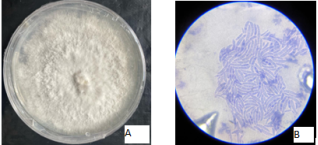
The 7-day-old pure culture of Fusarium sp. on PDA medium showed white, cottony-looking mycelium with rapid growth (0.81 cm/day). The center of the colony was slightly raised, indicating dense mycelial growth (Figure 3A). Microscopic observation (3B) shows that the spores are fusiform (spindle-shaped) with tapered ends. The macroconidia are septate, sparse, unicellular, and aggregated in clusters.
Figure 3. Macroscopic (A) and microscopic (B) appearance of Fusarium sp.
(i). Colletotrichum sp.
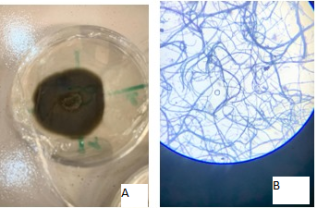
In a 14-day-old pure culture, Colletotrichum sp. has black mycelium and very slow mycelial growth (Figure 4). Macroscopically, the single acervuli, rarely in groups, sometimes resemble pycnidial bodies emerging from broken grayish-black spots. Setae are absent or barely visible at the base of the conidial mass. The conidial mass is dull white to dull orange or sometimes bright orange, with mycelium usually absent, but when present, it is white and shiny.
Figure 4. Macroscopic (A) and microscopic (B) appearance of Colletotrichum sp.
(ii). Mycosphaerella sp.
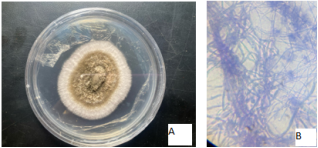
Mycosphaerella sp. Presents a grayish mycelium in the center and whitish at the periphery, with slow growth (0.53 cm/day) and a cottony appearance, growing radially and concentrically on PDA medium in pure culture after 7 days (Figure 5). Microscopically, the hyphae are filamentous and septate, forming a mycelial network.
Figure 5. Mycosphaerella sp: Macroscopic (A) and microscopic (B) appearance.
3.1.7. Effect of Fertilizers on Disease Incidence and Severity
(i). Effect of Fertilizers on Disease Incidence
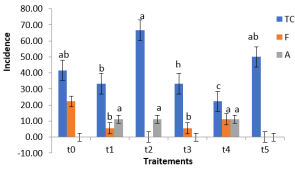
All treatments were affected by common spot disease (caused by Mycosphaerella sp.), unlike the other diseases. Fusarium wilt caused by (Fusarium sp.) affected four treatments, and anthracnose caused by (Colletotrichum sp.) was present in only three treatments.
Common spot disease had a higher incidence at T2 with an average of 66.67 and a lower incidence at T4.
Fusarium wilt was more prevalent at T2 with an average of 22.22, but was absent at T2 and T5.
Anthracnose had the same incidence in all treatments, namely 11.11. According to statistical analyses, no significant difference was observed between treatments, but nevertheless, the disease was absent at T0, T3, and T5.
Figure 6. Incidence according to treatment.
T0: negative control T3: compost at 10 t/ha
T1: chicken manure at 20 t/ha T4: compost at 20 t/ha
T2: chicken manure at 30 t/ha T5: NPK (14-24-14) at 100 kg/ha
(ii). Effect of Fertilizers on Disease Severity
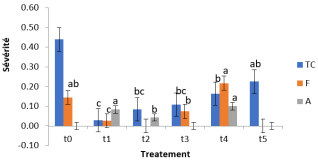
Figure 7 shows the severity of the various diseases observed on the plots. It shows that disease severity varies depending on the treatments. Statistical analysis showed that there is a significant difference between treatments, particularly purple spot disease, which was more severe at T0 than in the other treatments, Fusarium wilt, which was most severe in treatment T4, and anthracnose, which affected T1 and T4 more. The most prevalent disease was common leaf spot, which was present in all treatments, and the least prevalent disease was anthracnose.
Figure 7. Severity according to treatment.
T0: negative control T3: compost at 10 T/ha
T1: chicken manure at 20 T/ha T4: compost at 20 T/ha
T2: chicken manure at 30 T/ha T5: NPK (14-24-14) at 100 kg/ha
3.1.8. Pathogenicity Test Results
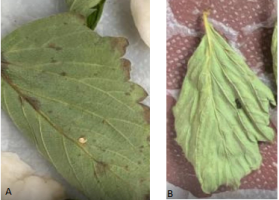
The leaves were inoculated with pure strains of Colletotrichum sp., Fusarium sp., and Mycosphaerella sp. Characteristic necrosis was observed only with pure strains of Mycosphaerella sp. (Figure 8). From 14 days after incubation at 25°C. Leaves inoculated with pure strains of Fusarium sp., on the other hand, showed no symptoms.
Figure 8. Necrosis on leaves after inoculation; Mycosphaerella sp. strain (A); Fusarium sp. strain (B).

3.2. Discussion
The results obtained during the study showed that fertilizers had a positive impact on various growth parameters, compared to the negative control. Chicken manure at 30 t/ha (T2) significantly improved strawberry growth parameters (plant height and leaf area) compared to other fertilizers. This improvement can be explained by the manure's high content of readily available nutrients (nitrogen, phosphorus), which promote vigorous vegetative growth. These results are consistent with those of Tswanya et al, who demonstrated that large quantities of chicken manure increased the height of okra plants . Similarly, studies by Chidiebere et al showed that chicken manure improved leaf area in corn of This improvement can be explained by the high content of readily available nutrients in the manure. Chemical treatment T5 (NPK 14-24-14 at 100 kg/ha) also yielded good results, especially in terms of the number of leaves and stolons, demonstrating its effectiveness on above-ground development. These observations are consistent with the work of Hossain et al which demonstrated that chicken manure at 27 tons per hour significantly improved sorghum growth, resulting in the tallest plants The assessment of the incidence and severity of the main leaf diseases affecting strawberries under different fertilization regimes revealed significant differences related to the type and dose of fertilizer used. The results show that the most common diseases are purple spot (Mycosphaerella sp.), red spot (Colletotrichum sp.), and brown spot caused by Fusarium sp. Their occurrence and intensity varied depending on the treatment. Organic treatments at moderate doses, particularly compost at 10 t/ha (T3) and chicken manure at 20 t/ha (T1), had the lowest incidence and severity, indicating a protective or regulatory effect against pathogens. These results are consistent with those of Masipa et al who observed that the use of compost improves soil structure, stimulates beneficial microflora, and limits the proliferation of pathogenic fungi . In contrast, treatments with high doses of organic matter (T2 and T4) and NPK mineral fertilizer (T5) were associated with a significant increase in the incidence and severity of leaf diseases. This observation corroborates the work of Coulibaly et al on tomatoes, which showed that excess nitrogen promotes foliage growth but also creates a humid microclimate conducive to fungal infections . Similarly Baggio et al reported a correlation between high nitrogen fertilization and increased susceptibility to Colletotrichum acutatum in strawberries Analysis of the results suggests that nutritional imbalance, particularly excess nitrogen, combined with excess soil moisture, could make plants more vulnerable to pathogens. This confirms the observations of Sargent et al according to which poor nutrition disrupts plant defense mechanisms .
Microscopic identification of isolated fungi (presence of septate hyphae, pigmentation on PDA) confirms the presence of Mycosphaerella, Colletotrichum, and Fusarium, already reported as major pathogens of strawberries in the work of
4. Conclusion
This research was guided by an overall objective to help evaluate the effect of different types of organic amendments (chicken manure and compost) and mineral amendments (NPK fertilizer) on the growth and health of strawberry plants.
In terms of vegetative growth, the amended plots showed a clear improvement in plant growth compared to the unfertilized control.
Manure at 30 t/ha (T2) generated the best performance in terms of vegetative growth.
High-dose treatments (T2, T4) and chemical fertilizers (T5) were associated with a higher incidence of fungal diseases.
The pathogens identified as being associated with the diseases are Colletotrichum sp., Fusarium sp., and Mycosphaerella sp., respectively.
Compost at 10 t/ha stands out as the most effective amendment, combining agronomic performance and disease resistance.
The judicious use of organic fertilizers appears to be a sustainable and accessible strategy for intensifying strawberry production in the mountainous areas of Cameroon.
Abbreviations

T

Treatment

PDA

Potato Dextrose Agar

I

Incidence

S

Severity

ISM

Desease Severy Index

Author Contributions
Tsama Njitat Valerie: Conceptualization, Supervision, Writing – original draft, Writing – review & editing
Kone Nsangou Abdou Nourou: Methodology, Writing – original draft, Writing – review & editing
Kacko Agripine: Conceptualization, Investigation
Conflicts of Interest
The authors declare no conflicts of interest.
References
[1] IPC. Internet. Available from:
[2] Lewers, K. S., Castro, P. R., Enns, J. M., Hokanson, S. C., Galletta, G. J., Handley, D. T., Jamieson, A. R., Newell, M. J., Samtani, J. B., Flanagan, R. D., Smith, B. J., Snyder, J. C., Strang, J. G., Wright, S. R., & Weber, C. A. ‘Flavorfest’ Strawberry. HortScience. 2017. 52(11), 1627?1632.
[3] Nakro, A., Khoulali, C., & Bamouh, A. Effect of potassium-nitrogen balance in fertilization on the productivity and quality of three strawberry varieties. Humanities, Management, Arts, Education & the Social Sciences Journal. 2020. 12 (2), Pp 37-44.
[4] FAOSTAT. Internet. Available from:
[5] Luhunga, P., Kidebwana, E. T., Kijazi, A., Chang’a, L., Ng’ongolo, H., Merchades, M., & Levira, P. The Contribution of the Global Framework for Climate Services Adaptation Programme in Africa (GFCS APA) in National Adaptation Plan (NAP) Process for Tanzania. Atmospheric and Climate Sciences, 2019. 09(04), Pp 650?661.
[6] Tchawa, P. Le Cameroon : An « Africa in miniature » The overseas notebooks, 2012. 65(259), 319?338.
[7] Ngouana, L. S. T., Tonfack, L. B., Temegne, C. N., Agendia, A. P., & Youmbi, E. Current status of strawberry (Fragaria spp.) cultivation and marketing in Cameroon. Journal of Agriculture and Food Research, 2023. 14(6) 100761.
[8] Masyahit M., Sijarn K., Awang Y., Ghazali M., et Satar M. G. M. The First Report of the Occurrence of Anthracnose Disease Caused by Colletotrichum gloeosporioides (Penz.) Penz. & Sacc. on Dragon Fruit (Hylocereus spp.) in Peninsular Malaysia. American Journal of Applied Sciences, 2009. 6(2): Pp 902-912.
[9] Bai, X., Liu, K., Ning, T., Deng, C., Wang, L., Li, D., Wang, T., & Li, J. Effects of multiple N, P, and K fertilizer combinations on strawberry growth and the microbial community. PLOSONE, 18(11), 2023.
[10] Perera F. P., Rauh V., Whyatt R. M., Tang D., Tsai W. Y., Bernert J. T., Tu Y. H., Andrews H. Barr D. B. Caann D. E., Diaz D. Dietrich J., Reyes A. and Kinney P. A Summary of recent findings on bireth outcomes and developmental effect Prenatal ETS, PAH, and Pesticide Exposures. Neuro toxicology. 2005 6(2), 573-587.
[11] Carole, D. A., Désiré, M. H., Souaibou, A., Célestine, M. E., Joël, B. N., Dioril, A. D., Didier, M. B., Charlen, N. I. B., Emmanuel, K., Xavier, K. F. A., Kevin, T. A. M., Motassy, M. D., Brice, A. S., Benjamin, A. A., Jones, N., Christophe, P. F., Oussena, N., Nicolas, N. Strawberry spp.) : Cultivation, Production, Consumption, and Marketing in Cameroon. Agricultural Sciences, 2024. 15(04), 449-471.
[12] Tswanya M. N. 1, Isah K. M. 2, Ahmed M. 1, Yisa P. Z. 1; Effect of Poultry Droppings on Growth and Fruit Yield of Okra (Abelmoschus esculentus). International Journal of Environment, Agriculture and Biotechnology. 2017.2(3), 1247?1251.
[13] Chidiebere P. E., John. A., Emmanuel, A., Paul, I., Elias Mjake, N., Nnenna Ogochukwu, O. Effect of Poultry Droppings and Inorganic Fertilizer on the Growth and Yield of Maize in Ikwo, Ebonyi State – Nigeria. World Journal of Agricultural Science and Technology. 2023.
[14] Hossain, A., Begum, P., Salma Zannat, M., Hafizur Rahman, Md., Ahsan, M., & Islam, S. N. Nutrient composition of strawberry genotypes cultivated in a horticulture farm. Food Chemistry. 2016. 19(9), 648‑652.
[15] Masipa, N. K. Assessing the impact of chicken compost application and water regime manipulation on selected soil properties and furarium wilt of tomato (Doctoral dissertation) 2023.
[16] Coulibaly, K., Amani, K., Essehi, J. L., Yao, G. F., Kouamé, B., & Nacro, H. B. Peasant perception of soil fertility management practices under market gardening in the Sub-perfecture of Djébonoua of Central Ivoiry Coast. Journal of Applied Biosciences, 2023. 1(82), 19088-19102.
[17] Baggio, J. S., Mertely, J. C., & Peres, N. A. (2020). Leaf Spot Diseases of Strawberry. EDIS, 2020. 11(6). PP 359.
[18] Sargent, D. J. Molecular genetics and genomics of the Rosoideae : State of the art and future perspectives. HorticultureResearch, 2014. 1(1).
[19] Zhang, H., Wang, H., Yang, Y., Li, M., Zhang, Y., Liu, J., Dong, J., Li, J., Butelli, E., Xue, Z., Wang, A., Wang, G., Martin, C., & Jin, W. The control of red colour by a family of MYB transcription factors in octoploid strawberry (Fragaria × ananassa) fruits. Plant Biotechnology Journal. 2020. 18(5), 1169-1184.
Cite This Article
  • APA Style

    Valerie, T. N., Nourou, K. N. A., Agripine, K., Durielle, A. M. J., Zachee, A. (2026). Effect of Organic and Chemical Fertilizers on the Growth and Diseases of Strawberries (Fragaria ananassa var Charlotte). Plant, 14(1), 24-32. https://doi.org/10.11648/j.plant.20261401.12

    Copy | Download

    ACS Style

    Valerie, T. N.; Nourou, K. N. A.; Agripine, K.; Durielle, A. M. J.; Zachee, A. Effect of Organic and Chemical Fertilizers on the Growth and Diseases of Strawberries (Fragaria ananassa var Charlotte). Plant. 2026, 14(1), 24-32. doi: 10.11648/j.plant.20261401.12

    Copy | Download

    AMA Style

    Valerie TN, Nourou KNA, Agripine K, Durielle AMJ, Zachee A. Effect of Organic and Chemical Fertilizers on the Growth and Diseases of Strawberries (Fragaria ananassa var Charlotte). Plant. 2026;14(1):24-32. doi: 10.11648/j.plant.20261401.12

    Copy | Download

  • @article{10.11648/j.plant.20261401.12,
      author = {Tsama Njitat Valerie and Kone Nsangou Abdou Nourou and Kacko Agripine and Awoufack Momo Junith Durielle and Ambang Zachee},
      title = {Effect of Organic and Chemical Fertilizers on the Growth and Diseases of Strawberries (Fragaria ananassa var Charlotte)},
      journal = {Plant},
      volume = {14},
      number = {1},
      pages = {24-32},
      doi = {10.11648/j.plant.20261401.12},
      url = {https://doi.org/10.11648/j.plant.20261401.12},
      eprint = {https://article.sciencepublishinggroup.com/pdf/10.11648.j.plant.20261401.12},
      abstract = {The intensification of agriculture and the ongoing degradation of soils in the highlands of western Cameroon are compromising the sustainability of vegetable production systems, particularly that of strawberries (Fragaria ananassa), a crop that is increasingly valued in the region. This study aims to evaluate the effect of different types of organic amendments (chicken manure and compost) and mineral amendments (NPK fertilizer) on the growth and health of strawberry plants. The experiment was conducted using a completely randomized block design with six treatments: a control (T0), two doses of chicken manure (20 t/ha, T1; 30 t/ha, T2), two doses of compost (10 t/ha, T3; 20 t/ha, T4) and a chemical treatment (NPK 14-24-14 at 100 kg/ha, T5), each repeated three times. The parameters studied included: vegetative growth (height, leaf area, stolons), incidence and severity of leaf diseases. Pathogens were identified using identification keys and microscopic observations of pure strains obtained on PDA medium. The results revealed that organic amendments significantly improved plant growth. Manure at 30 t/ha (T2) generated the best performance in terms of vegetative growth. However, high-dose treatments (T2, T4) and chemical fertilizer (T5) were associated with a higher incidence of fungal diseases, with Colletotrichum sp., Fusarium sp., and Mycosphaerella sp. identified as the main pathogens. Compost at 10 t/ha stands out as the most effective amendment, combining agronomic performance and disease resistance. The adoption of organic fertilizers could therefore be a significant asset in sustainably improving strawberry production in the highlands of western Cameroon.},
     year = {2026}
    }
    

    Copy | Download

  • TY  - JOUR
    T1  - Effect of Organic and Chemical Fertilizers on the Growth and Diseases of Strawberries (Fragaria ananassa var Charlotte)
    AU  - Tsama Njitat Valerie
    AU  - Kone Nsangou Abdou Nourou
    AU  - Kacko Agripine
    AU  - Awoufack Momo Junith Durielle
    AU  - Ambang Zachee
    Y1  - 2026/04/20
    PY  - 2026
    N1  - https://doi.org/10.11648/j.plant.20261401.12
    DO  - 10.11648/j.plant.20261401.12
    T2  - Plant
    JF  - Plant
    JO  - Plant
    SP  - 24
    EP  - 32
    PB  - Science Publishing Group
    SN  - 2331-0677
    UR  - https://doi.org/10.11648/j.plant.20261401.12
    AB  - The intensification of agriculture and the ongoing degradation of soils in the highlands of western Cameroon are compromising the sustainability of vegetable production systems, particularly that of strawberries (Fragaria ananassa), a crop that is increasingly valued in the region. This study aims to evaluate the effect of different types of organic amendments (chicken manure and compost) and mineral amendments (NPK fertilizer) on the growth and health of strawberry plants. The experiment was conducted using a completely randomized block design with six treatments: a control (T0), two doses of chicken manure (20 t/ha, T1; 30 t/ha, T2), two doses of compost (10 t/ha, T3; 20 t/ha, T4) and a chemical treatment (NPK 14-24-14 at 100 kg/ha, T5), each repeated three times. The parameters studied included: vegetative growth (height, leaf area, stolons), incidence and severity of leaf diseases. Pathogens were identified using identification keys and microscopic observations of pure strains obtained on PDA medium. The results revealed that organic amendments significantly improved plant growth. Manure at 30 t/ha (T2) generated the best performance in terms of vegetative growth. However, high-dose treatments (T2, T4) and chemical fertilizer (T5) were associated with a higher incidence of fungal diseases, with Colletotrichum sp., Fusarium sp., and Mycosphaerella sp. identified as the main pathogens. Compost at 10 t/ha stands out as the most effective amendment, combining agronomic performance and disease resistance. The adoption of organic fertilizers could therefore be a significant asset in sustainably improving strawberry production in the highlands of western Cameroon.
    VL  - 14
    IS  - 1
    ER  - 

    Copy | Download

Author Information